
Partial Eligibility & Mixed-Item Purchases
Not every product qualifies for full HSA or FSA reimbursement. Some items are only partially eligible, and some orders contain a mix of eligible and ineligible products. Understanding how partial eligibility works helps you claim the right amount and avoid issues with your administrator.
What is partial eligibility
Partial eligibility means that only a portion of what you paid may qualify for reimbursement through your HSA or FSA.
This typically happens in two situations:
- A single product serves both a medical and an everyday purpose. For example, a mattress can be medically supportive, but you would buy a basic mattress regardless. Because a basic mattress is a normal expense you would incur anyway, only the amount you pay above a comparable basic mattress may be eligible. The cost of the basic mattress itself is not reimbursable.
- An order contains both eligible and ineligible items. For example, a cart that includes a qualifying air purifier alongside a non-medical accessory like a decorative cover. The air purifier may be eligible for qualified customers, while the accessory is not.
Under IRS incremental-cost rules, HSA and FSA funds may cover only the amount above what a comparable basic version costs. Submitting a claim for more than the eligible amount could result in a denial or require you to repay funds.
How the eligible portion is determined
You do not need to calculate the eligible amount yourself. Truemed’s provider team determines it for you as part of the qualification process.
Here is how it works:
-
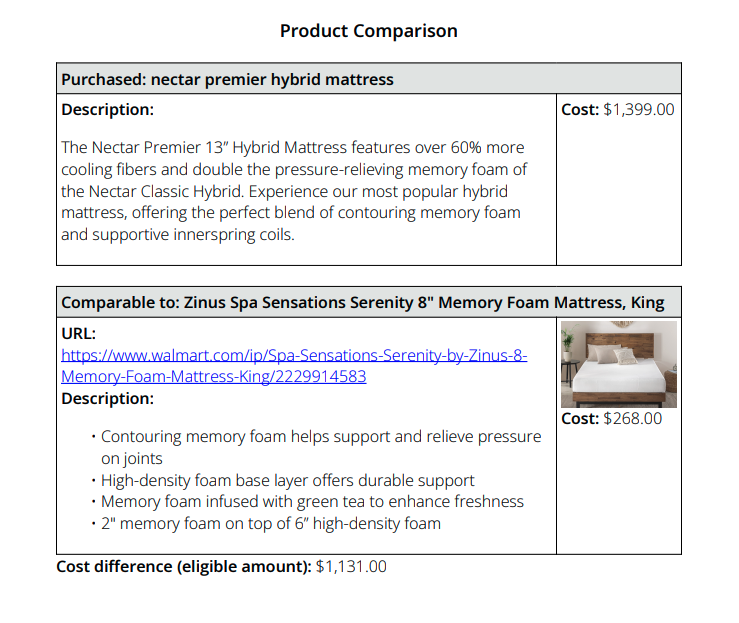
Comparable basic version. Truemed compares your purchase to a comparable basic version that meets the same everyday need, in the same size. The price of that basic version is the ineligible portion, because it is a normal expense you would incur anyway. The remaining amount, which reflects the medically relevant features, is the eligible portion. For example, a king mattress with therapeutic features priced at 268, has an eligible amount of 268 basic baseline treated as ineligible.
-
Your LMN addendum. After qualification, your Letter of Medical Necessity includes an addendum that specifies the eligible amount for your purchase. This is the amount you may claim.
-
Your Truemed receipt. Your receipt itemizes the eligible and ineligible amounts separately, so there is no guesswork when you fill out your reimbursement claim.
.png "Mattress receipt (partially eligible)")
You pay the full price of the product at checkout, and then you submit only the eligible portion for reimbursement. The ineligible portion is covered by your regular payment method and cannot be reimbursed through your HSA or FSA.
Submitting a claim for mixed purchases
When your purchase includes both eligible and ineligible items or amounts, follow these steps:
- Locate your Truemed receipt. It will show the eligible amount clearly separated from the ineligible amount.
- Locate your LMN and any addendum. The addendum confirms the eligible amount determined by Truemed’s provider.
- Log into your HSA or FSA administrator’s portal and navigate to the reimbursement or claims section.
- Enter only the eligible amount when filling out your claim. Do not submit the full purchase price if part of it is ineligible.
- Upload your supporting documents. Attach your Truemed receipt and your LMN. Some administrators may also request a cost comparison document (see the documentation section below).
- Submit and save your confirmation number.
If your administrator’s claim form only has a single amount field, enter the eligible portion shown on your Truemed receipt, not the total order amount.
What documentation is required
To support a partial eligibility or mixed-purchase claim, you will typically need the following:
- Letter of Medical Necessity (LMN) with addendum. The addendum is the part of your LMN that specifies the eligible amount for your specific purchase. Both the LMN and addendum are provided by Truemed after qualification.
- Truemed itemized receipt. This receipt breaks down the eligible and ineligible amounts and includes the merchant name, product description, and date of purchase, everything your administrator needs to review the claim.
- Cost comparison document (if requested). Some administrators require a cost comparison showing how the eligible amount was calculated relative to a comparable basic version. For common products, Truemed automatically includes this documentation. If your administrator asks for it and you do not have it, contact support@truemed.com with your order details and the team will send it to you.
Submitting all three documents together in your initial claim reduces the likelihood of follow-up requests and speeds up processing.
Common examples
Here are some products where partial eligibility commonly applies:
- Premium mattress with therapeutic features. A basic mattress is something you would buy anyway, so its cost is not reimbursable. Only the amount above a comparable basic mattress, reflecting the therapeutic features, may be eligible.
- High-end treadmill vs. basic model. A treadmill may be eligible for qualified customers for cardiovascular or physical-therapy reasons. Only the amount above a comparable basic qualifying model is eligible; the cost of the basic model is not.
- Smart air purifier. An air purifier may be eligible for qualified customers for respiratory reasons. Only the amount above a comparable basic purifier is eligible; the basic-unit cost is not reimbursable.
- Premium orthopedic footwear. Orthopedic footwear may be eligible for qualified customers for certain foot or joint conditions. Because you would buy a basic pair of shoes anyway, only the amount above a comparable basic pair may be eligible.
In each case, your Truemed receipt and LMN addendum reflect the exact eligible amount so you always know what to submit.